

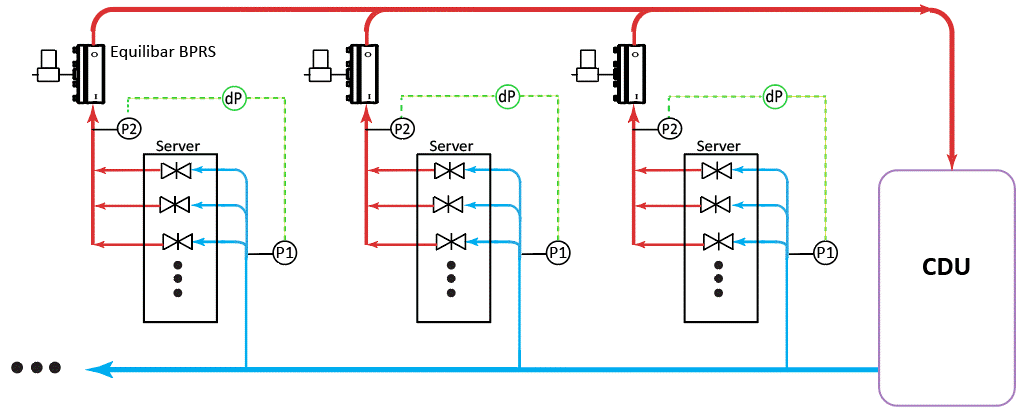
Within the last few years, there has been a rapid shift in the cooling methodology for servers used within data centers. Modern AI accelerators and high-performance computing hardware generate extraordinary amounts of heat — often exceeding 1,000 watts per module. Almost all (>99%) of the power consumed by a computer is converted to heat, which has driven the industry towards two-phase refrigerants and liquid cooling, as opposed to older air-based cooling systems. In both manufacturing test systems and production data centers, coolant is distributed from a central Coolant Distribution Unit (CDU) through a manifold that feeds each server tray in a rack in parallel. The fundamental hydraulic challenge is the same in both settings.
The Challenge: How to maintain a consistent differential pressure (dP) across a rack manifold when the flow demand can rapidly change
A common setup within liquid cooled server racks is to have a small, motorized valve, such as a stepper motor driven needle valve, connected to the cold plates in each tray within a rack. These needle valves control the flow to each individual tray but require a constant differential pressure (from cold side supply to hot side return) to achieve predictable flow for a given % opening of the needle valve. As the Open Compute Project’s Cold Plate Cooling Loop Requirements document notes, a rack manifold “must be able to deliver the flow rate required to cool the ITE (IT Equipment), at a targeted pressure drop and provide a uniform flow distribution within the rack; this requires careful design considerations.”
Transient fluctuations such as spikes in compute demand or the removal of one or more trays, can cause rapid dramatic shifts in the amount of flow required for a rack. “Hot swaps” of trays are common within manufacturing/QA test environments but can occur within production data centers as well. Traditional control methods, such as characterized ball valves paired with flow meter and/or dP sensors often struggle to respond to these rapid changes in flow. With the high power densities of modern hardware, even a delay of a few seconds can result in thermal throttling or even damage to components.
The Equilibar Solution: Dome-Loaded Back Pressure Regulation
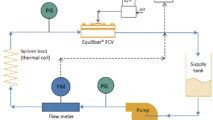
Equilibar’s dome-loaded diaphragm back pressure regulators (BPRs) are installed on the outlet (hot water return) side of each rack manifold, where they actively restrict flow to maintain a user-defined dP setpoint across the rack. Unlike traditional pressure-independent control valves (PICVs) designed for steady-state HVAC systems, Equilibar BPRs use a frictionless, fluid-filled dome reference chamber that responds to pressure disturbances in real time — with no actuator travel time, no control loop hunting, and no minimum detectable error threshold.

The result is sub-second flow restabilization after a disturbance, compared to 10 seconds or more for conventional motorized control valves. For applications where server trays are routinely hot-swapped, this difference is not incremental — it is the difference between a system that holds thermal stability and one that experiences repeated transient excursions on every neighboring cold plate.
Application Spotlight: Cooling for Server Test Systems (Manufacturing)
Before they reach production data centers, each IT tray in a server undergoes extensive validation in dedicated test systems that replicate the thermal and hydraulic conditions of the eventual deployment environment. These systems are intentionally dynamic: trays enter and exit racks continuously as units complete testing cycles, and the cooling loop must accommodate the resulting step changes in hydraulic demand without interrupting neighboring units under test.
In this context, an Equilibar BPR installed at the rack outlet maintains a constant dP setpoint across the manifold regardless of how many trays are active. When a tray is removed, the sudden reduction in flow demand would otherwise cause a pressure spike that redistributes flow across the remaining cold plates. The Equilibar valve opens proportionally in milliseconds to absorb the excess pressure and maintain the setpoint. When a tray is reinserted, the valve closes to restore balance, ensuring the dP across the rack remains constant.
Application Spotlight: Cooling in Production Data Centers
The same hydraulic instability that plagues test systems exists in production data centers, particularly during planned maintenance events, incremental rack population during deployment, or reconfiguration of compute loads. The OCP Manual Control Valve white paper identifies flow balancing across racks of differing power loads as a core design challenge : “It is essential to have knowledge of the hydraulic curves illustrating the pressure drop of the selected valve at various opening angles… the pressure drop is precisely defined based on the cooling circuit within the rack.”
While OCP documentation describes manual control valves (MCVs) as one approach to this balancing problem, MCVs require the system configuration to be well-documented in advance and are adjusted infrequently. They are inherently static solutions not suited for dynamic conditions often seen in actual use. An Equilibar BPR provides continuous, automatic adjustment — maintaining the target dP in real time as compute loads shift and rack configurations evolve.
For large-scale deployments with racks of varying power density along a distribution header, an Equilibar BPR at each rack outlet allows each rack to hold its own dP setpoint independently of what is happening hydraulically in neighboring racks. This eliminates the “robbing” effect, where a high-flow rack starves adjacent lower-flow racks of coolant, without requiring a Tichelmann loop or complex pipe balancing.
Contact Us About Your Application
The Equilibar Advantage
- 100:1 turndown ratio — the valve operates accurately from maximum design flow down to 1% of that flow, accommodating a nearly empty rack or a fully populated one without reconfiguration.
- Near-instantaneous transient response — frictionless diaphragm actuation means the valve tracks set point without the delay inherent in electrically or pneumatically actuated designs. Unlike control valves, which rely on a reading from a dP sensor, processing by PID loop, and then a change in position of the valve, Equilibar valves instantaneously adjust their Cv to keep the upstream pressure constant.
- Multi-orifice design — eliminates cavitation risk even at high pressure differentials
- Simple controls – No need for external feedback and PID – set a specific target pressure and the valve will adjust its Cv dynamically to maintain the setpoint as flow changes.
These properties make the Equilibar BPR particularly well-suited to liquid cooling applications where flow demand is variable by design, hydraulic conditions are not fully known in advance. The traditional solution for these systems, characterized ball valves paired with dP, temperature, and flow sensors, is generally incumbent due to their prevalence within the HVAC industry. While the overall cooling loop design can be similar to liquid chillers used for traditional HVAC systems the nature of the system transients and the consequences of deviation from set temperature could not be further apart; failure to respond to transient conditions in an HVAC system may result in momentary discomfort, but within a server rack this sluggish response has an immediate effect on chip junction temperatures, effecting the lifespan and performance of the ITE.
Specifications and Sizing Equilibar BPRs for Cooling Loops
Equilibar BPRs for data center liquid cooling applications are available in a range of body sizes and orifice configurations to match specific rack flow rates and target dP setpoints. Common coolant compatibility includes deionized water, propylene glycol/water mixtures (with fluid conductivity maintained below approximately 1,500 µS/cm at 25°C per OCP guidelines), and other non-aggressive water-based coolants. Wetted materials are selected to meet data center coolant compatibility requirements. Triclamp or flanged connections are readily available as well, for systems where the use of threaded connections is avoided to prevent fouling of cold plates and heat exchangers with thread sealant.
Contact Equilibar to discuss sizing for your specific rack hydraulic profile, including CDU supply pressure, target rack dP, maximum and minimum expected flow rates, and coolant fluid specification.
Speak to an Engineer to Learn More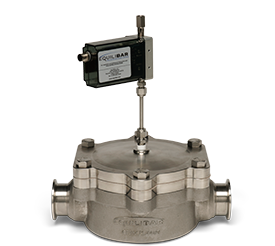
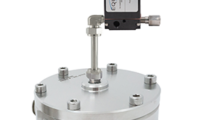
Equilibar 1 1/2″ IC Series back pressure regulator with Triclamp fittings
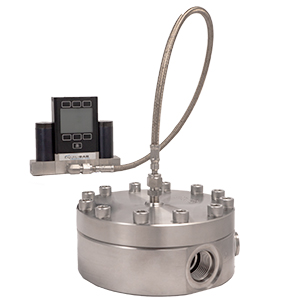
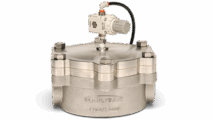
Equilibar GSD dome loaded back pressure regulator with instantaneous transient response