


While the Equilibar® valve is inherently a back-pressure regulator, it can be used as a pressure reducing valve (PRV) for highly accurate pressure-reducing control by varying the pilot pressure in response to a downstream pressure measurement. Equilibar regulators excel in pressure-reducing applications that push far beyond the limits of conventional regulators and control valves. This includes ultra-high and ultra-low differential pressures, conditions prone to cavitation, aggressive chemistries, mixed-phase or rapidly changing phases, solids and particulates, and applications requiring exceptionally wide turndown ratios.
Most standard PRVs or control valves will struggle or fail under these conditions, while the Equilibar’s multiple-orifice diaphragm design gives it the stability and responsiveness needed to maintain precise control where traditional devices become unstable, wear prematurely, or simply cannot operate.

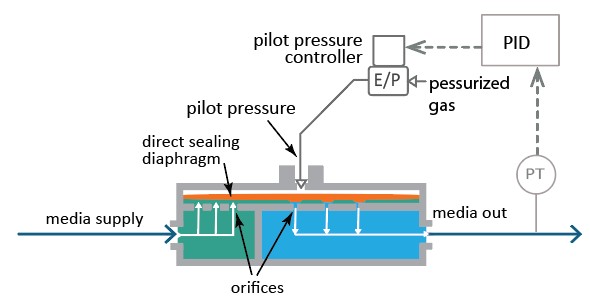
An Equilibar valve set up for pressure-reducing control using a downstream pressure transmitter in PID loop
How Equilibar Valve Works as a PRV
The Equilibar control valve is used in forward (downstream) pressure control by setting up a control loop with an electronic pilot controller and a downstream pressure transmitter (PT). The proportional-integral-derivative (PID) controller monitors feedback from the PT and adjusts the pilot pressure to throttle flow and maintain the downstream pressure setpoint. An electro-pneumatic (E/P) controller converts the PID’s electronic input into a pneumatic pilot signal for the Equilibar valve.
Downstream pressure is decreased by raising the pilot actuation pressure (which tightens the diaphragm and restricts flow) and increased by lowering the pilot pressure (allowing the diaphragm to lift and pass more flow).
Using an Equilibar BPR in this PRV configuration can present tuning challenges from certain asymmetries in the flow versus pilot relationship. High-speed PID systems are best suited for this situation, especially for those applications requiring fast response to changing conditions. Successful customers have a controls engineer on staff.
Contact Us For InformationWhen to Consider Using an Equilibar Valve for Pressure Reduction
The Equilibar fluid control valve is particularly well suited for demanding or unconventional requirements, including:
- Flow coefficient (Cv) ranges wider than traditional valves (>100:1)
- Highly corrosive gases and liquids (available in exotic alloys; diaphragms available in FFKM and other engineered elastomers)
- High temperature operation (seal options up to 500 °C)
- Sanitary and biopharmaceutical service (USP Class VI diaphragm options)
- Extremely low flow rates (controls Cv down to 1E-9)
- Two-phase, phase-change, and supercritical fluids
- Extremely low ΔP and extremely high ΔP applications
- Solids and particulates
- Polymer wetted materials for harsh or incompatible chemistries
- Cavitation, flashing, and choked-flow regimes
These are the types of scenarios where traditional pressure-reducing regulators often become unstable, erode quickly, or simply cannot control. The Equilibar’s diaphragm-driven design provides sensitivity, robustness, and rangeability that typical regulators cannot match.
Contact an Equilibar Application Engineer to discuss how this solution can benefit your application.
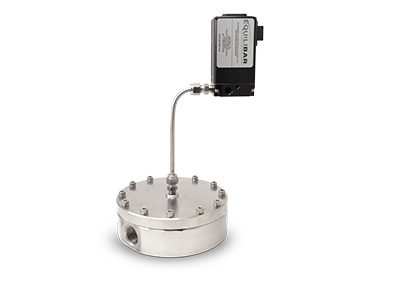
Equilibar GSD6 with electronic pilot regulator can be set up in a PID loop for pressure reduction control
