

Accurate flow control is important across a wide range of industries and processes, from managing gases in research and manufacturing to controlling liquids in chemical, energy, semiconductor, and other demanding applications. Maintaining the desired flow rate improves process consistency, product quality, and overall system performance.
Two challenges engineers frequently encounter are controlling flow across a wide operating range and maintaining the desired flow as process pressures change.
Controlling Flow Across a Wide Operating Range
Many processes do not operate at a single flow rate. A system may need extremely low flow during one stage of operation and substantially higher flow during another. Accordingly, performance test systems often test across a wide range of flow rates. This can make valve selection challenging, particularly when one valve needs to provide accurate control across the entire operating range.
Equilibar® flow control valves (FCVs) can operate across a flow range of approximately 100:1, providing significant turndown within a single valve. This wide operating range can be especially useful for processes with changing production requirements, multiple operating conditions, or applications that require precise control at both lower and higher flow rates.
The Equilibar design differs significantly from a traditional control valve. Instead of using a single variable opening, a flexible diaphragm interacts with multiple parallel orifices. As the diaphragm moves, it progressively exposes more or less flow area. This unique design provides fine resolution at low flow while also allowing substantially more flow area to become available as demand increases.
Watch as we demonstrate how an Equilibar FCV controls accurately across a 100:1 control range
Maintaining Flow as Process Pressure Changes
Another common flow control challenge occurs when upstream or downstream process pressures vary. Because flow through a valve is influenced by the pressure differential across it, changing system pressures can cause the flow rate to move away from the desired setpoint.
Equilibar flow control valves are extraordinarily responsive because they rely on a thin and supple diaphragm as the control mechanism. Even in closed-loop flow control with a feedback loop, Equilibar valves compensate quickly for changing conditions. A flow meter measures the actual process flow and sends feedback to a controller. The controller compares the measured flow with the desired setpoint and adjusts the pressure on the diaphragm as needed to maintain the target flow.
The Equilibar flow control valve will continuously adjust its opening as process conditions change and the corresponding feedback from the flow meter signals a change.
A specific example is with oil well injection applications that involve the injection of a fluid into the bottom of the well to improve conditions of the well. These are a challenge for flow control valves because the downstream pressure of the wellhead can vary greatly with conditions and flow rate inside the well. In addition, the required injection flow rate can vary greatly as well.
Combined with a flow meter and high resolution electropneumatic pilot controller, an Equilibar flow control valve can serve as a highly responsive method for maintaining the desired flow rate for applications where varying process conditions are common.
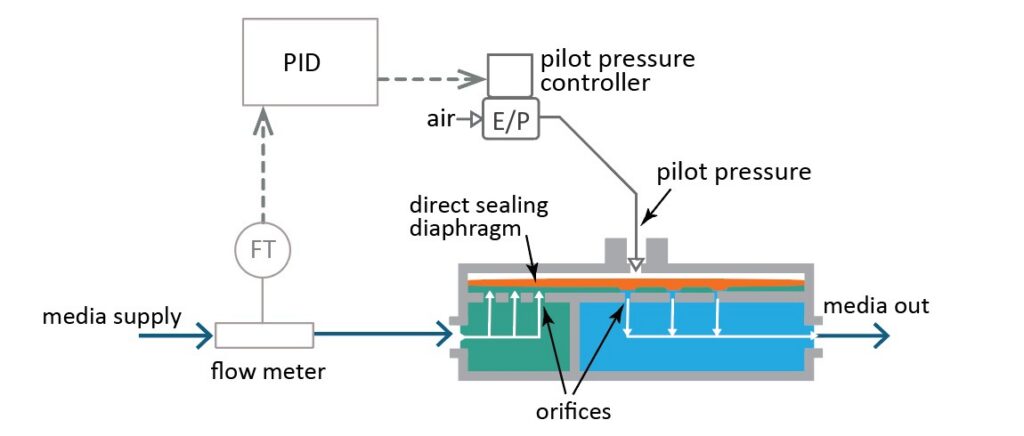
Equilibar multi-orifice flow control valve
Equilibar Flow Control Valves are Available for Low and High Flow Applications
Equilibar Research Series valves have been used in complex flow control applications for many years. Here are a few case studies where you can read more about them:
- Equilibar regulator improves dosing flow control in polyolefin research
- Berlin Customer Uses Equilibar to Provide Flow Control for High Temperature Vinyl Acetate Monomer Reactor
Recently, customers have been using Equilibar flow control valves in higher flow applications using our GS Series valves (Cv range 1E-03 to 8.5) and our new IC Series valves (Cv range 1E-02 to 60).
Equilibar IC series, our latest innovation in regulating valves, provides best-in-class high flow performance in a compact size and, like other Equilibar valves, are easily customized for a variety of applications. Key advantages are shorter lead times (2-3 weeks for in-stock models); premium materials (dual-certified CF3M/1.4409 stainless steel); and flexible process connections (NPT, ANSI RF Flange, and tri-clamps stocked standard with DIN flanges, BSPP threaded ports, and other connections available upon request).
Other Challenging Situations in which Using an Equilibar Flow Control Valve is Beneficial:
- Highly corrosive gases and liquids
- High temperature or cryogenic service
- Sanitary and biopharmaceutical applications
- Extremely low flow rates
- Two-phase, phase-change and supercritical states
- Extremely low DP and extremely high DP
Whether the challenge is controlling flow across a wide operating range, responding to changing process pressures, or capably handling extreme conditions, we encourage you to contact an Equilibar application engineer for help selecting a valve with the appropriate range and control characteristics for your flow control system.