


Rated to 150 psig, the new device delivers clean, stable flow while remaining fully drainable and hygienic
On July 28, Equilibar introduced its new Pulsation Dampener (PD) for biopharma processes. Engineered to reduce pressure fluctuations caused by the action of positive displacement pumps and other process equipment, the PD meets the stringent hygienic requirements of biopharmaceutical applications while also maintaining the integrity of sensitive processes.
“The PD offers multiple benefits for complex sanitary applications,” said Megan Cider-Elm, Life Sciences Product Director for Equilibar and Steriflow Valve. “It improves cell viability by reducing shear related cell damage, it promotes consistent cell stoichiometry, and it provides smoother, more stable flow to downstream equipment. The end result is improved overall process yield.”
Using an air-loaded, double-sided active dampening design, the Equilibar PD provides responsive pulsation control. Unlike most pulsation dampeners on the market, which function as passive shock absorbers, Equilibar’s Pulsation Dampener dynamically regulates pressure fluctuations by adding energy to the system. This creates a more uniform pressure profile by elevating pressure troughs and reducing pressure peaks. It features a small footprint, a wide range of sizes, and operates up to 150 psi (10 bar) and 135°C to allow CIP cleanability. Designed for easy maintenance, the PD meets the criteria of demanding sanitary applications where cleanliness, uptime, and product integrity are critical.

Typical applications for the PD include:
- Cell Culture Media Transfer
- Perfusion Systems
- Tangential Flow Filtration (TFF)
- Chromatography
- Buffer Preparation and Transfer
- Filling operations
The need for pulsation dampeners
A pulsation dampener—also called damper in some markets—is used to improve process effectiveness by reducing pulsating flows caused by positive displacement pumps. Dampeners reduce pulsations to ensure a smooth fluid flow so that processes downstream of the pump are accurate, efficient and safe. Pulsation dampening is particularly important in biopharmaceutical processing due to the sensitivity of the upstream cells and downstream biomolecules to changing process conditions.
In bioprocessing, pulsations can create upstream and downstream processing challenges including:
- Difficulty in measuring flow accurately, affecting process control
- Stress on delicate cells or biomolecules
- Decreased filtration effectiveness due to variability in TMP
- Disturbances in chromatography resin
- Possible inaccuracies in filling
All of these situations cost time and money or affect product yield and quality.
How the Equilibar PD Works
The Equilibar Pulsation Dampener is installed downstream of a positive displacement pump or anywhere pressure pulsation is a concern. It uses pneumatics to adjust its internal pressure in response to the force and direction of each pulsation amplitude. The double-sided dampening is air-loaded on the non-wetted side of each of two diaphragms through a shared line on the side of the device. Excess air exhausts through exhaust ports. The system requires a standard gas pressure regulator to set the pressure of the dampener supply gas.
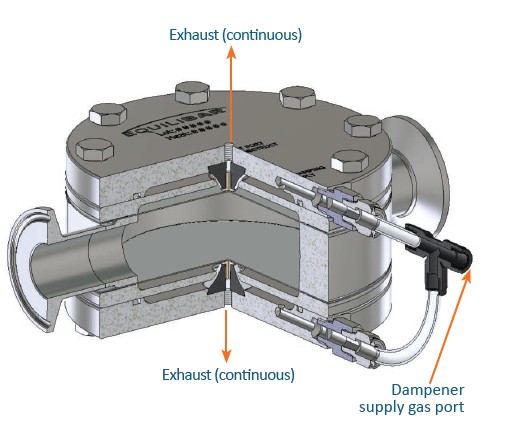
More information including schematics and videos is available on Equilibar’s website: Sanitary Pulsation Dampener for Biopharma Processes
Equilibar’s experienced application engineers welcome inquiries about this exciting new product line at inquiry@equilibar.com or via our convenient contact option.