


Fluid control terminology can be confusing, even for experienced professionals. Moreover, preferred usage sometimes varies according to specific geographic locations, industries and applications. Consult our glossary below for practical explanations of flow and pressure control terms. Feel free to contact us with questions and comments. Disclaimer: While this glossary has been carefully compiled, definitions are based on Equilibar’s interpretation and experience and may at times vary from specific definitions used by others
Absolute pressure
Air-loaded valve
Back pressure controller
Back pressure reducing valve
Back pressure regulator (BPR)
Back pressure valve
Ball valve
Bernoulli equation
Butterfly valve
Bypass valve
Cavitation
Centrifugal pump
Check valve
Closed-loop control
Compressible flow
Coriolis flow meter
Cv
Density
Derivative control mode
Diaphragm regulator (valve)
Differential pressure
Dome-loaded regulator (valve)
Electronic pressure regulator
Flow chemistry
Flow coefficient of a valve (Cv)
Flow control valve
Gate valve
Gauge pressure
Globe valve
Ideal gas law
Inches water column (in WC)
Incompressible flow
Integral control
Laminar flow (laminar regime)
Lobe pump
Magnetic flow meter
Mass flow meter (MFM)
Mixed-phase flow
Multi-phase flow
Needle valve
Non-Newtonian fluid
Open-loop control
Peristaltic pump
PID controller
Pilot operation
Pipe friction
Positive displacement pump
Pressure reducing regulator (PRR)
Pressure reducing valve (PRV)
Pressure sustaining valve
Proportional control
Proportional valve
Pump slip
Reference
Relief valve
Rotameter
Tangential flow filtration (TFF)
Thixotropic shear thinning
Turbulent flow
Two-phase flow
Vacuum breaker
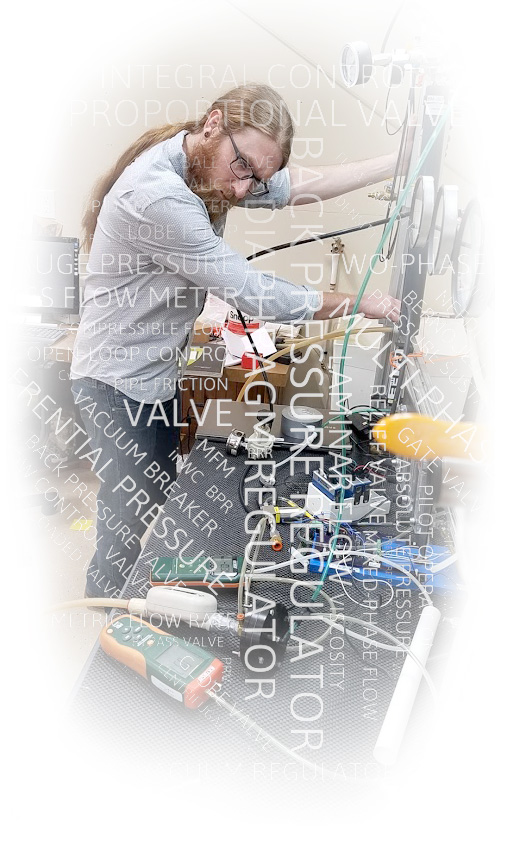

Team Member Spotlight: Ryan Patterson, Application Engineer
Application Engineer Ryan Patterson is a native of Western North Carolina who joined the Equilibar team late last year. He earned his bachelor’s degree from Western Carolina University down the road in Cullowhee, North Carolina. His previous work experience included time as a design engineer and then an application engineer with Hapco and Morgan Advanced Read More
Read More