


The term flow chemistry, also called continuous flow chemistry, refers to the process of running chemical reactions in a continuously flowing stream through tubular reactors, as opposed to running one batch at a time in a vat or other container. While flow chemistry is not a new technique, it is becoming more and more popular for laboratory and pharmaceutical applications because of its many advantages, which include improved heat transfer, ease of automation, and safety. For more information, see this discussion on the Equilibar Flow Chemistry application page .
Absolute pressure
Air-loaded valve
Back pressure controller
Back pressure reducing valve
Back pressure regulator (BPR)
Back pressure valve
Ball valve
Bernoulli equation
Butterfly valve
Bypass valve
Cavitation
Centrifugal pump
Check valve
Closed-loop control
Compressible flow
Coriolis flow meter
Cv
Density
Derivative control mode
Diaphragm regulator (valve)
Differential pressure
Dome-loaded regulator (valve)
Electronic pressure regulator
Flow chemistry
Flow coefficient of a valve (Cv)
Flow control valve
Gate valve
Gauge pressure
Globe valve
Ideal gas law
Inches water column (in WC)
Incompressible flow
Integral control
Laminar flow (laminar regime)
Lobe pump
Magnetic flow meter
Mass flow meter (MFM)
Mixed-phase flow
Multi-phase flow
Needle valve
Non-Newtonian fluid
Open-loop control
Peristaltic pump
PID controller
Pilot operation
Pipe friction
Positive displacement pump
Pressure reducing regulator (PRR)
Pressure reducing valve (PRV)
Pressure sustaining valve
Proportional control
Proportional valve
Pump slip
Reference
Relief valve
Rotameter
Tangential flow filtration (TFF)
Thixotropic shear thinning
Turbulent flow
Two-phase flow
Vacuum breaker
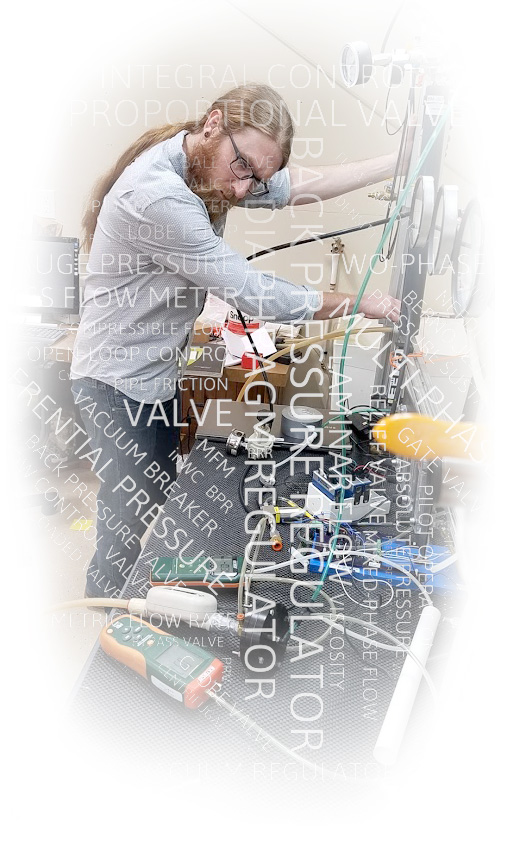

For complex applications, Equilibar® valves can provide reliable pressure-reducing control
Equilibar’s multiple orifice diaphragm technology has become a favorite for providing back pressure control, vacuum control, and flow control, but in certain applications it can also provide distinct advantages as a pressure reducing valve (PRV) that is able to perform where conventional valves cannot. Equilibar devices excel in pressure-reducing applications that push far beyond the Read More
Read More