


Certain pressure control problems involve factors such as remote control, automation, or data collection that require an electronic device. In the past decade, the fastest growing type of electronic pressure regulator (EPR) has been the servo valve design, which uses two high speed servo or solenoid valves to increase or decrease gas pressure as needed to maintain pressure. These EPRs offer higher pressures and more flexibility and robustness than previous technologies, which were often marketed as electro-pneumatic transducers. Servo EPRs work by using a push valve and a vent valve to maintain the outlet pressure at the desired setpoint. A small internal pressure sensor monitors the output pressure and a digital or analog controller adjusts the timing of the servo valves to maintain the set-point. See our page on How Electronic Pressure Regulators Work for more information.
Absolute pressure
Air-loaded valve
Back pressure controller
Back pressure reducing valve
Back pressure regulator (BPR)
Back pressure valve
Ball valve
Bernoulli equation
Butterfly valve
Bypass valve
Cavitation
Centrifugal pump
Check valve
Closed-loop control
Compressible flow
Coriolis flow meter
Cv
Density
Derivative control mode
Diaphragm regulator (valve)
Differential pressure
Dome-loaded regulator (valve)
Electronic pressure regulator
Flow chemistry
Flow coefficient of a valve (Cv)
Flow control valve
Gate valve
Gauge pressure
Globe valve
Ideal gas law
Inches water column (in WC)
Incompressible flow
Integral control
Laminar flow (laminar regime)
Lobe pump
Magnetic flow meter
Mass flow meter (MFM)
Mixed-phase flow
Multi-phase flow
Needle valve
Non-Newtonian fluid
Open-loop control
Peristaltic pump
PID controller
Pilot operation
Pipe friction
Positive displacement pump
Pressure reducing regulator (PRR)
Pressure reducing valve (PRV)
Pressure sustaining valve
Proportional control
Proportional valve
Pump slip
Reference
Relief valve
Rotameter
Tangential flow filtration (TFF)
Thixotropic shear thinning
Turbulent flow
Two-phase flow
Vacuum breaker
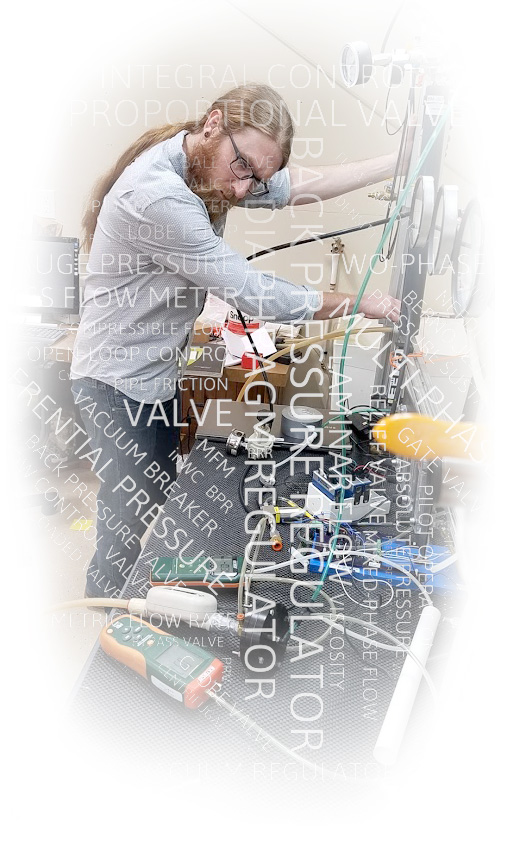

For complex applications, Equilibar® valves can provide reliable pressure-reducing control
Equilibar’s multiple orifice diaphragm technology has become a favorite for providing back pressure control, vacuum control, and flow control, but in certain applications it can also provide distinct advantages as a pressure reducing valve (PRV) that is able to perform where conventional valves cannot. Equilibar devices excel in pressure-reducing applications that push far beyond the Read More
Read More