


Equilibar® PD Sanitary Pulsation Dampener
The Equilibar® PD Series Sanitary Pulsation Dampener is engineered to reduce excessive pressure fluctuations caused by positive displacement pumps and other process equipment while meeting the hygienic requirements of biopharmaceutical and sanitary processing. Its cleanable, drainable design supports CIP/SIP applications and helps maintain the integrity of sensitive processes.
Benefits of the Equilibar PD
- Extends the service life of filtration membranes and chromatography columns
- Improves cell viability and reduces shear-related cell damage
- Promotes consistent stoichiometry and process conditions
- Improves overall process yield
- Provides smoother, more stable flow to downstream equipment
Design Highlights
- 316/316L stainless steel body standard
- Optional body materials: 1.4435 stainless steel and HC-22
- All wetted materials are USP Class VI and FDA-compliant PTFE
- Available in line sizes from ¼ in. to 3 in.
- Standard sanitary Tri-Clamp end connections
- Cleanable and drainable design (vertical installation recommended)
- Pressure rating up to 150 psig (10 bar[g])
- Temperature rating up to 135°C
- Air-loaded, double-sided dampening technology for superior pulsation control
Why Choose the Equilibar® PD?
Unlike conventional pulsation dampeners with passive dampening techniques, the Equilibar PD uses an air-loaded, double-sided active dampening design that provides responsive pulsation control. It has a small footprint, a wide range of sizes, and operates up to 150 psi (10 bar) and 135°C to allow CIP cleanability.
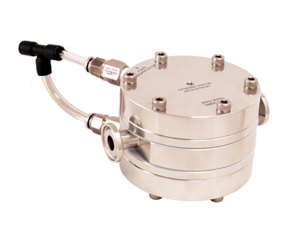
Equilibar 1/4″ Sanitary Pulsation Dampener (PD) with active dampening technology

Equilibar PD in vertical orientation for maximum drainability
How the Equilibar PD works
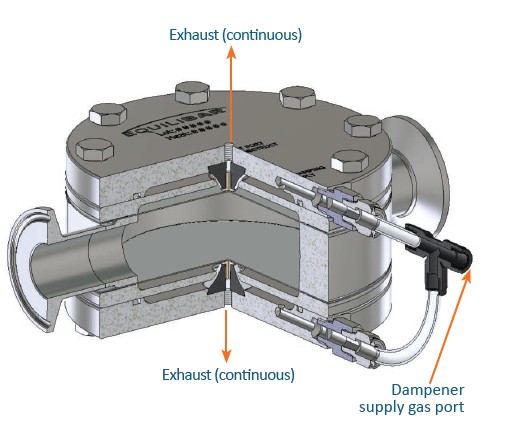
The Equilibar Pulsation Dampener is installed downstream of a positive displacement pump or where pressure pulsation is a concern. It uses pneumatics to adjust its internal pressure in response to the force and direction of each pump pulsation against the diaphragms, reducing pulsation amplitude.
The double-sided dampening is air-loaded on the non-wetted side of each diaphragm through a shared line in the side of the PD. Excess air exhausts through the exhaust ports on each cap. See figure to the right.
The system requires a gas pressure regulator to set the pressure of the dampener supply gas. To achieve maximum dampening, the supply pressure must be slightly higher than the average process pressure and tuned for each application. The supply pressure should not exceed 150 psig (10 bar[g]). Contact us for more information.
Performance of the Equilibar Pulsation Dampener
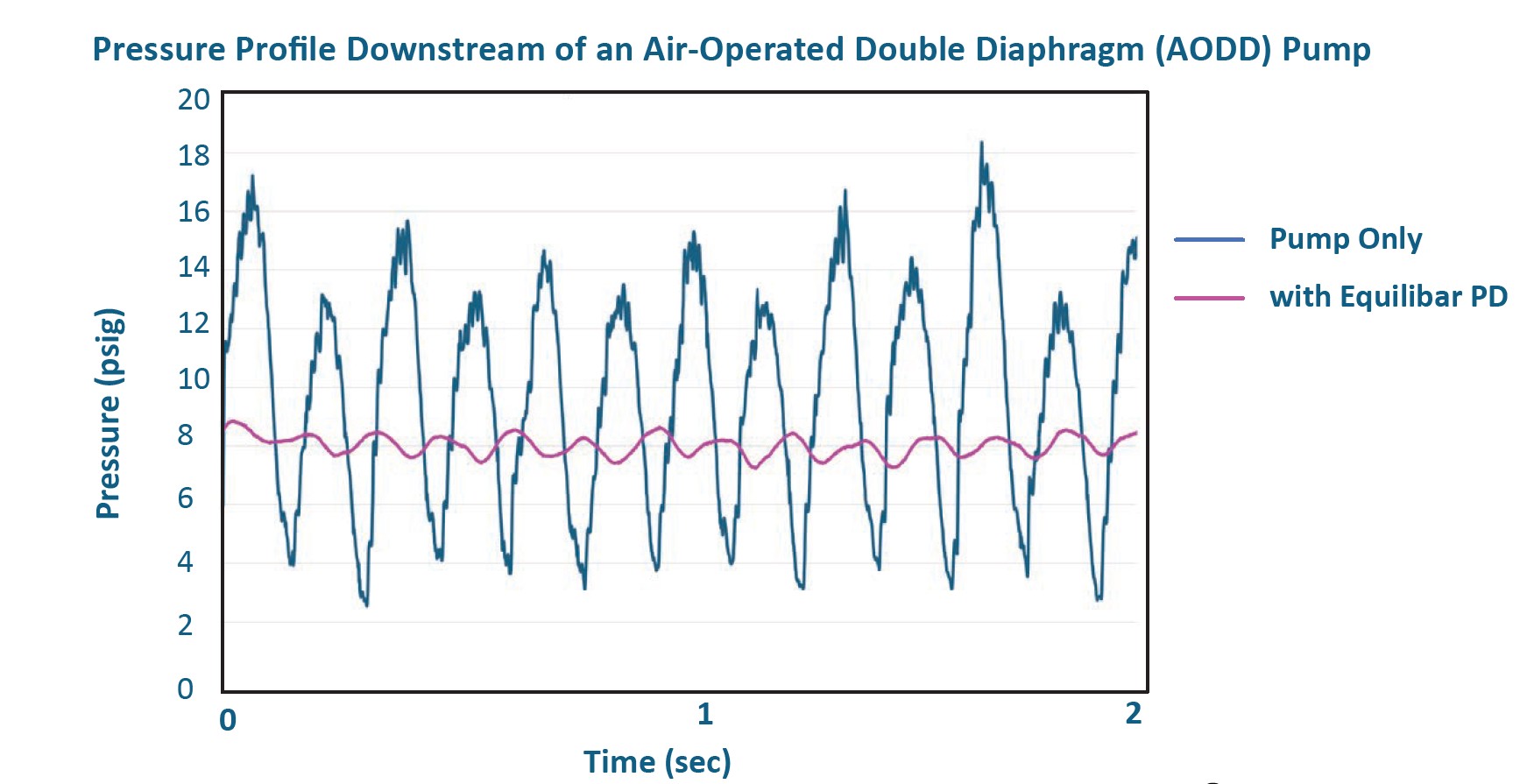
The easiest way to identify pulsations in a system is to evaluate a system’s pressure profile. Below is a plot of pressure data collected downstream of an air-operated double diaphragm (AODD) pump. This snapshot shows the downstream pressure profile at the pump outlet with the pump only and with an Equilibar PD dampener. Results will vary depending on pump type, line size and process layout.
Typical Applications for Equilibar PD
- Cell culture media transfer
- Perfusion systems
- Tangential flow filtration (TFF)
- Chromatography systems
- Buffer preparation and transfer
- Filling operations
Looking for a single use pulsation dampener?

Equilibar PD in delivery line to chromatography column