


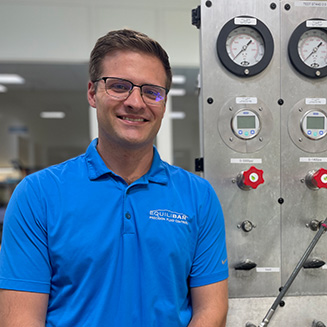
Lead Design Engineer Marty Kowall provides continuity and collaboration between Equilibar’s work in Asheville and the work of other Richards Industrials product lines in Cincinnati, helping to strengthen the technical efforts at both sites.
Originally from Cleveland, Ohio, Marty earned a bachelor’s degree in mechanical engineering technology from the University of Cincinnati. He then worked as quality manager for a machine shop for two years before joining Richards as a project engineer.
“While I was at Richards, I learned about a lot about fluid control in general but working in New Product Development gave me the chance to focus on particular valve designs and gain in-depth knowledge about how they operate,” he said. “My main project was the Sanitary Safety Relief Valve, which we were excited to release earlier this year.”
At Equilibar, Marty conducts testing to gather data and enhance the design and performance of Equilibar devices. “The vastly different global projects that use Equilibar technology always intrigues me. The multitude of industries that we serve is quite humbling. Working on these applications provides opportunities to learn about many areas of scientific research that I wouldn’t otherwise be exposed to.”
Marty also provides technical support to production. In this role, he builds on his experience in the machine shop environment as well as his engineering expertise.
Marty was excited to move to the Asheville area because of the wealth of outdoor activities. “Right now my favorite activity is hiking. I love exploring the different areas of Western North Carolina. I want to get more into fly fishing, camping, and kayaking in the future.”