

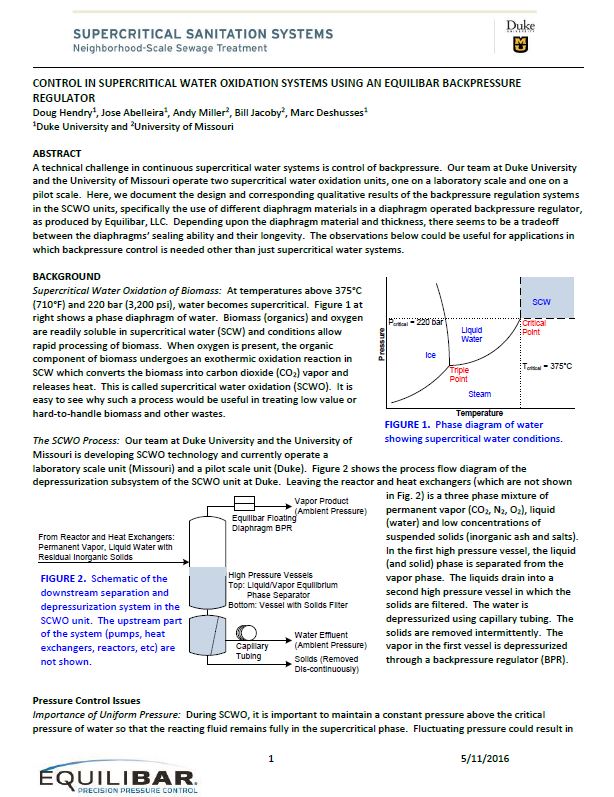
Researchers at Duke University and the University of Missouri are using an Equilibar back pressure regulator to develop a Supercritical Water Oxidation (SCWO) system to improve waste water treatment. The system is intended to be used globally, especially in areas that lack infrastructure for centralized waste water treatment.
This important environmental research relies on the Equilibar to provide pressure control that enables the reaction to occur in the supercritical phase. During the supercritical phase, biomass and oxygen are relatively soluble in water and conditions allow for rapid processing of biomass. The Equilibar also improves the process by dampening pulsations caused by pumps or changes in the heat of reaction.
This paper details research done with several diaphragms in an Equilibar regulator to find the one best suited for fully continuous operation.
Read Customer Case Study: Control In Supercritical Water Oxidation Systems Using An Equilibar Back Pressure Regulator