


The rapid adoption of AI over the past few years has led to a corresponding rapid shift in cooling methodology for servers used within data centers. Modern AI accelerators and high-performance computing hardware generate extraordinary amounts of heat — often exceeding 1,000 watts per module — which has driven the industry towards two-phase refrigerants and liquid cooling as opposed to older air-based cooling systems.
In these systems, the coolant is distributed from a central Coolant Distribution Unit (CDU) through a manifold that feeds each server tray – Direct to Chip (D2C) – in a rack in parallel.
Maintaining consistent differential pressure (dP) across the manifolds is essential, but it is also extremely challenging due to the rapid changes in flow rate that frequently occur due to spikes in computer demand, the removal of server trays, and other transient fluctuations.
Traditional control methods, such as characterized ball valves paired with flow meter and/or dP sensors, often struggle to respond to these rapid changes in flow. Unfortunately, with the high power densities of modern hardware, a delay of just a few seconds can result in thermal throttling or even damage to components.
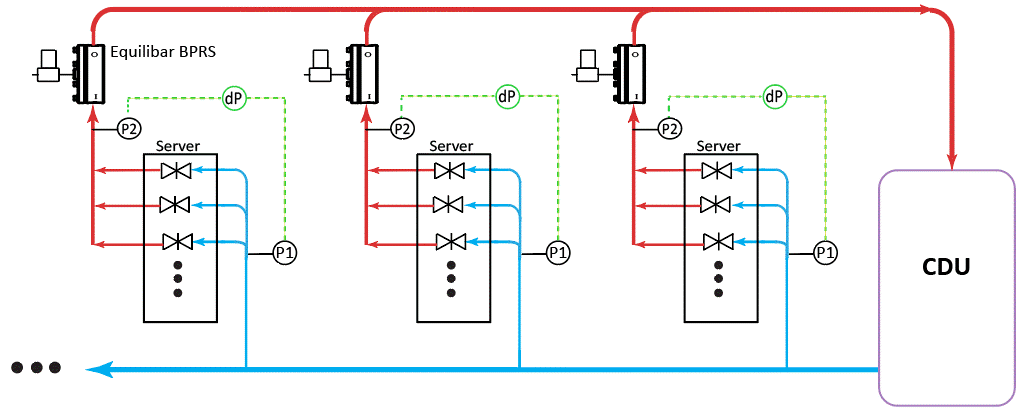
The Equilibar Solution: Dome-Loaded Back Pressure Regulation
A good alternative to traditional pressure control systems is to install Equilibar® dome-loaded diaphragm back pressure regulators (BPRs) on the outlet (hot water return) side of each rack manifold where they actively restrict flow to maintain a user-defined dP setpoint. Unlike traditional pressure-independent control valves designed for steady-state HVAC systems, Equilibar BPRs use a frictionless, fluid-filled dome reference chamber that responds to pressure disturbances in real time, with no actuator travel time, no control loop hunting, and no minimum detectable error threshold.
The result is stabilization in less than a second following a disturbance, compared to 10 seconds or more for conventional motorized control valves, which can mean the difference between a system that holds thermal stability and one that experiences repeated transient excursions.
Read our new application page on Differential Pressure Control for Liquid-Cooled Server Racks for more in-depth technical details. And please be sure to contact our experienced application engineers, who are familiar with all types of fluid control challenges, or email inquiry@equilibar.com