


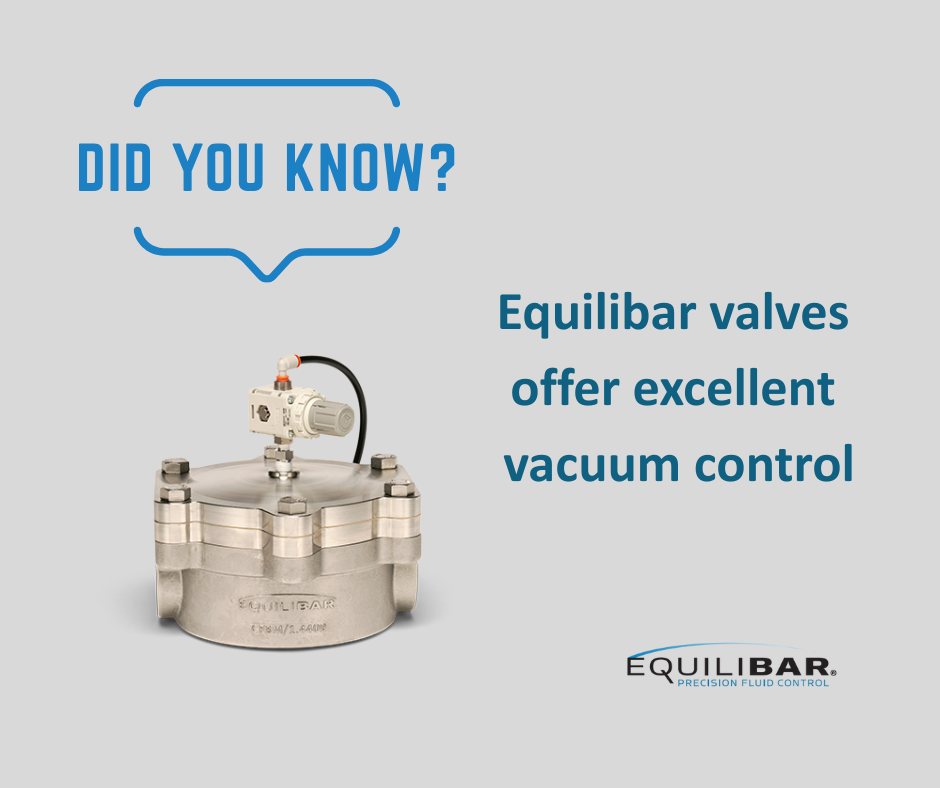
Due to their simple and flexible design, Equilibar® dome-loaded valves can easily be set up to provide vacuum control as well as positive pressure control. This is true of our smallest LF and HF valve series all the way up to our larger IC series. In all situations, the pressure on the inlet port is maintained in a precise one-to-one relationship to the pressure applied to the pilot port on the dome. If a vacuum pressure is applied to the pilot port, then the Equilibar valve will control that same vacuum pressure on its inlet port. Similarly, if a positive pressure is applied to the dome, then the valve will control to that setpoint.
Here’s how it works:
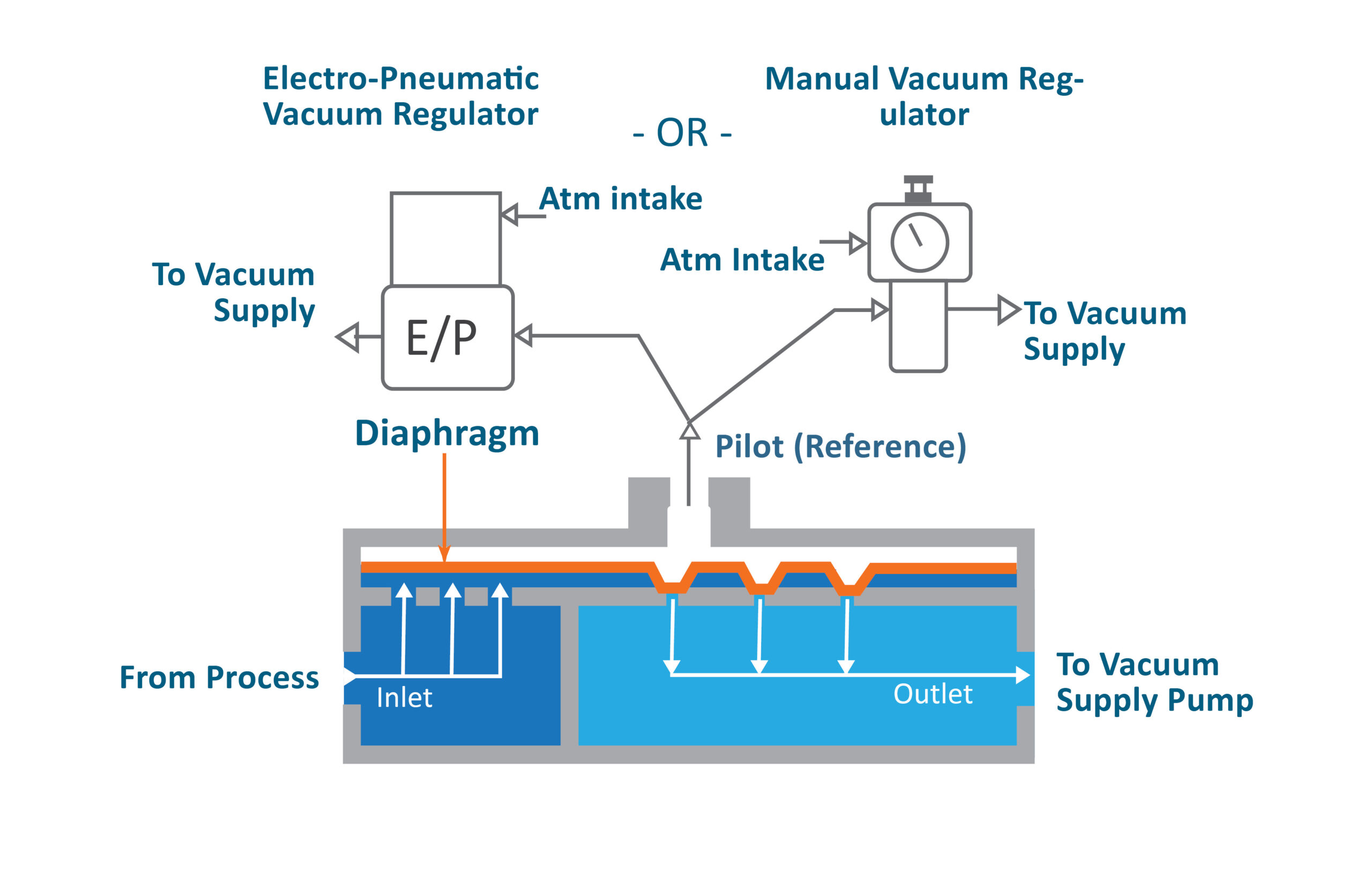
Equilibar® devices rely on an ultra-sensitive technology in which multiple orifices are sealed by a thin and supple diaphragm. As flow requirements change, the diaphragm moves a few millimeters to open and close over some or all of the orifices, providing instantaneous and frictionless control. Because Equilibar regulators are dome-loaded, the setpoint is controlled by fluid pressure on the dome.
To provide vacuum control, Equilibar valves use a pneumatic vacuum pilot regulator to set the desired vacuum setpoint on the dome. (By contrast, Equilibar back pressure regulators use a positive pilot pressure regulator to set a positive pressure setpoint.)
Equilibar valves can also control vacuum through positive pressure. The key is simply finding the right type of pressure regulator that can cross from negative to positive and then apply that signal to the pilot port of Equilibar regulator.
The pneumatic pilot setpoint pressure may be set with either a manual or electronic pilot regulator to provide unmatched vacuum stability across widely varying flow rates.
Equilibar vacuum valves offer key benefits for challenging applications
By adding a vacuum pilot regulator to the dome of an Equilibar valve fed by the vacuum source, the Equilibar valve operates as a vacuum control valve that offers the same wide Cv control range and excellent low flow control as our ground-breaking back pressure regulators and flow control valves.
Additional benefits include easy process automation, ultra-fast action, improved accuracy and chemical compatibility.
As a result, Equilibar vacuum valves have become favorites for demanding applications such as chemical distillation, vacuum holding tables, landfill gas extraction, battery manufacturing, vacuum drying in pharmaceutical manufacturing, and semiconductor fabrication.
It should be noted that Equilibar vacuum regulators and valves are non-relieving and non-bleeding. This technology is not capable of rapidly increasing the pressure on the inlet port and is intended for processes where at least a very small gas flow is present at all times. For a detailed explanation of the important difference between a vacuum regulator and a vacuum breaker, see our Vacuum Page.
Our fluid control application experts are well versed in vacuum control solutions and are always happy to discuss demanding scenarios. We invite you to contact them to discuss your unique situation.
