



Semiconductor manufacturing involves some of the most complex industrial processes ever developed. The processors in our modern computers, phones, cars and appliances are produced via a long sequence of manufacturing steps, each requiring ultra-precise engineering, cutting-edge materials, and nanoscale fabrication techniques.
Fluid control plays an integral role in several of these steps, including the extremely complex fabrication of integrated circuits or chips.
With their dome-loaded design and exceptional precision, Equilibar® back pressure regulators and vacuum regulators are well suited to provide fluid control for semiconductor manufacturing. In addition, Equilibar engineers have years of experience working on applications that require extreme precision, compatibility with incredibly aggressive fluids, and exceedingly fast response times, making them especially well-equipped for this technically demanding industry.
Our new Semiconductor Pages highlight some of the key steps in semiconductor manufacturing in which Equilibar technology excels. These include the following:
Front-End-of-Line (FEOL) is the first step in which individual components such as transistors and logic gates are patterned into the wafer substrate. Equilibar vacuum regulators are especially useful for wafer handling due to their precise control, easy automation, instantaneous response to changes in flow, wide operating flow range, and isolation from downstream supply fluctuations. In addition, Equilibar high temperature back pressure regulators perform well while controlling the pressure within annealing/passivation chambers in which temperatures of 250-400 C and gas pressures of 10-30 bar are common. Stable control of pressure within a chamber allows for a faster, more uniform diffusion of hydrogen/deuterium into the wafer.
Back-End-of-Line (BEOL) is the process in which metal interconnect layers are deposited onto the wafer, connecting the various transistors and other components. During the thin film deposition phase of this step, Equilibar regulators are especially useful for positive pressure or vacuum control due to the extreme precision they provide as well as their ability to handle severe temperatures and their ease of automation. 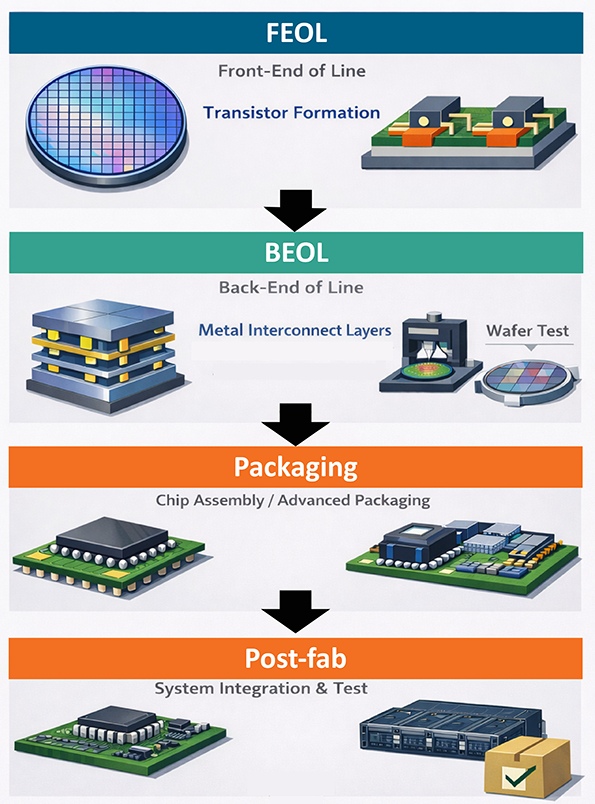
Advanced Packaging is the process in which chips are integrated into their final package after they have been sliced from the wafer. Traditionally, this involves encapsulating the chip within a case while also incorporating electrical contacts that connect to a larger board. Regardless of the specific chip, this assembly process involves robotic pick-and-place automation. Equilibar vacuum regulators have long provided solutions for demanding pick-and-place applications thanks to their wide operating flow range and ability to respond instantaneously to changes in flow, adjusting their Cvs to maintain a constant vacuum setpoint.
Post-fab occurs when the final product is integrated into larger components, such as a motherboard or server tray. Thermal stress testing, performance testing and other tests may be done on the final product. Of these, the most demanding procedures from a fluid controls perspective are usually thermal tests, which involve the use of liquid cooling loops. Equilibar valves are popular for liquid cooling loops due to their wide rangeability that accommodates vast differences in the amount of water being recirculated. Equilibar valves also offer flexibility of control inputs since they can be used to control flow or even temperature in addition to back pressure and vacuum.
Please visit our Semiconductor Manufacturing Pages to learn more about the multiple ways Equilibar technology can provide solutions for the complex processes involved in chip fabrication:
And, as always, we encourage you to contact our experienced application engineers who have experience in all types of fluid control challenges.
Contact an Engineer