


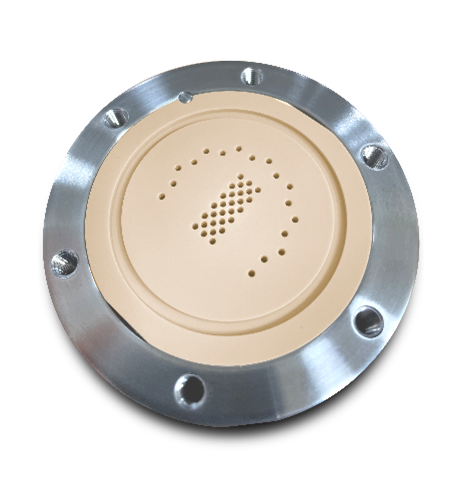
Equilibar engineers are pleased to offer new design options to provide superior fluid control for applications that involve both high pressures and extremely harsh chemistries.
These valves and regulators feature a metal cradle that encircles and supports a polymer body. The two parts work together to provide chemical compatibility and safety for applications with severe chemistries and high pressures, even high-pressure gas. The polymer inserts and other wetted components can be customized for specific demands, making them suitable for microreactors, pilot-scale systems or full-scale production systems.
Continuous flow chemistry applications, in particular, are a good match for the new design options because they often require a full-polymer flow path due to the presence of corrosive chemicals. At the same time, they can also involve high pressures, resulting in process conditions that are beyond the capabilities of traditional back pressure regulators and valves.
Key benefits of the new design include:
- A stainless steel cradle that allows for pressures up to 1500 psig / 103 bar(g)
- A regulator body that is available in PEEK, PTFE, PVDF and CPVC to accommodate a variety of harsh chemicals.
How It Works
Equilibar’s direct-sealing diaphragm technology allows for infinite customization. The simple design of Equilibar valves and regulators features a thin, supple diaphragm (membrane) as the only moving part. The diaphragm, valve body and cap, O-rings and bolts can all be customized and made of materials designed for a particular application’s needs in terms of chemical compatibility and pressure requirements as well as temperature and flow.
In this revolutionary technology, a flexible diaphragm forms a seal on multiple orifices. A pilot pressure fluid (usually gas) is applied to the top of the diaphragm to maintain a pressure balance with the process fluid flowing through the body of the unit. As fluids flow, the Equilibar® regulator holds the process pressure equal to the pilot setpoint pressure above the diaphragm. If the upstream process pressure exceeds the setpoint, the diaphragm lifts off the orifices to release pressure. When the flow is minimal, only a portion of one orifice will engage to release the pressure. When the flow is high, the diaphragm is pushed up to engage all the orifices.

Equilibar’s revolutionary fluid control technology is well suited to provide back pressure control, flow control and vacuum control. We also offer a range of high-performance pressure-reducing regulators, electronic regulators and manual pilot regulators to provide comprehensive fluid control.
As always, we invite you to contact one of our experienced engineers to discuss your particular fluid control challenge. They look forward to hearing from you!
